Learning a language as a child is one of the greatest gifts a parent can give. Whether you have Croatian roots, a Croatian partner, or simply want your child to grow up bilingual – the good news is that kids are natural language sponges, and with the right approach, learning Croatian can feel less like studying and more like playing.
It is the easiest for kids to learn other languages since they are not actively learning it, more so picking up language skills as they do everyday things, play, watch TV and sing.
Teaching Croatian to children is one of my greatest joys. As much as it can be challenging at the beginning, I love it when we reach the point where we play games and communicate fully in Croatian.
However, don’t forget the power of the parent. If you speak Croatian, even if it is not perfect, add it to everyday communication with your kid. Play games, such as find an item of this colour – crvena, plava, etc., or communicate about their day, what they did, what they ate… It doesn’t need to be much, but even a little bit goes a long way.
The role of the parent in learning Croatian for kids
Kids look up to their parents, parents are everything to them, and parents have a huge role in their learning Croatian.
There are two main roles you can take, depending on whether Croatian is your native language or if you speak a little or no Croatian at all. If you don’t speak Croatian, that is completely ok! It is not expected that you start speaking with your kid, but you can take an interest in their new activity and learn basic greetings like:
- Dobro jutro! – good morning
- Dobar dan! – good day
- Dobra večer! – good evening
- Laku noć! – good night
If you, however, speak Croatian, take any opportunity to speak with your kids, even if you don’t speak it perfectly. Remember, when kids are young, they are like a sponge, and they don’t need to spend hours with a book to pick up a skill like speaking another language. Foundations that are set in young age (5-8 years old) will help them tremendously in the future.
Make it a daily habit - learn Croatian language everyday
Everything counts, and that is especially the case with learning a 2nd language. Your kid probably cannot sit still for hour-long lessons – but the great thing is that he doesn’t! Incorporate Croatian into your daily routine; consider speaking Croatian only in the morning or reading a story in Croatian before bedtime.
- Morning greetings — start every day with Dobro jutro!
- Mealtimes — name foods, ask for things in Croatian
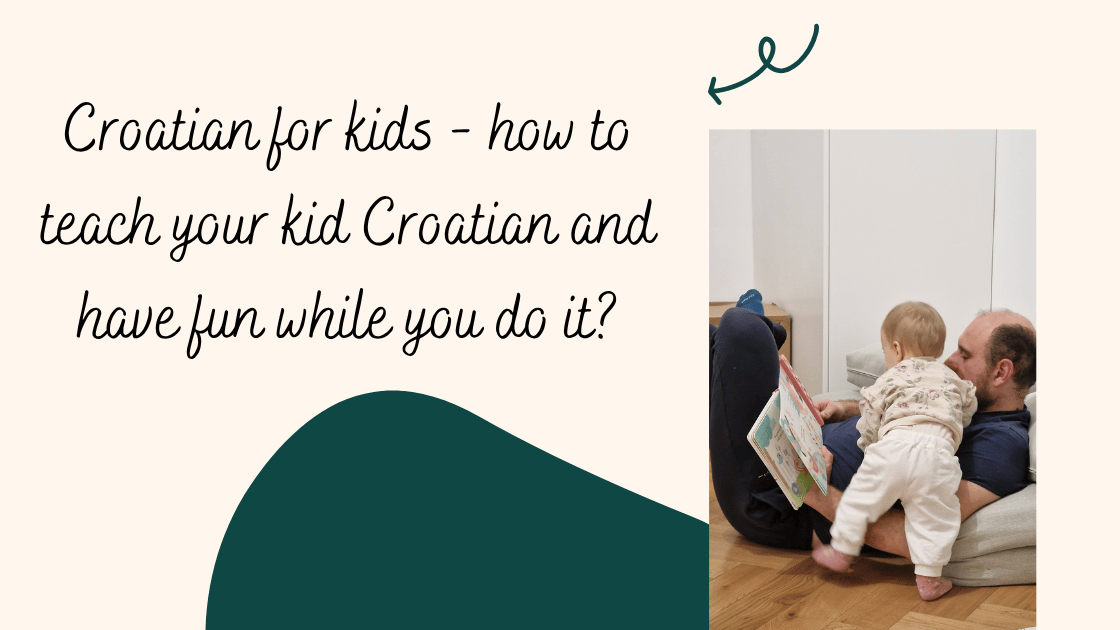
- Bedtime — read one short Croatian book or sing one song
Children thrive on routine, and a small Croatian ritual woven into the day adds up faster than you’d think.
Another great way to start is by practicing all the Croatian alphabet letters, from correct pronunciation to learning more words that start with that letter.
Which resources I need to support my kid learning Croatian?
Your patience and presence, just by being there and showing love towards Croatian is more than enough. But from my years of teaching Croatian to kids and adults and more than 3000 lessons, I learned that some materials work better than others.
Furthermore, from my experience, students and families who surround themselves with language through books, songs, and trips to Croatia tend to learn faster!
1. Croatian picture books
Colourful, story-driven pages build vocabulary naturally and give children something to return to again and again. Look for bilingual editions so you can follow along together.
2. Croatian workbooks
Designed for young learners, workbooks reinforce writing, reading, and structure in a playful, low-pressure way – great for building confidence between lessons. (Download one for free below!)
3. Croatian songs & radio
Rhythm and melody are among the fastest routes to fluency. Try Hana Baby Channel (turn on the subtitles and sing along) or Bravo! kids – audiostories for more advanced kids.
4. Croatian food
Cook palačinke or burek together while naming ingredients. Sir, jaja, tijesto, brašno… kids will learn about Croatian culture and their heritage, while practicing basics like ingredients. Turning language into a sensory experience is one of the most effective (and delicious) ways to make it stick.
5. Everyday communication
Greetings, feelings, school phrases, mealtimes — this is the real foundation. Download my free printable guide with essential phrases and basics, such as colors and shapes, for you to practice with your kid.